


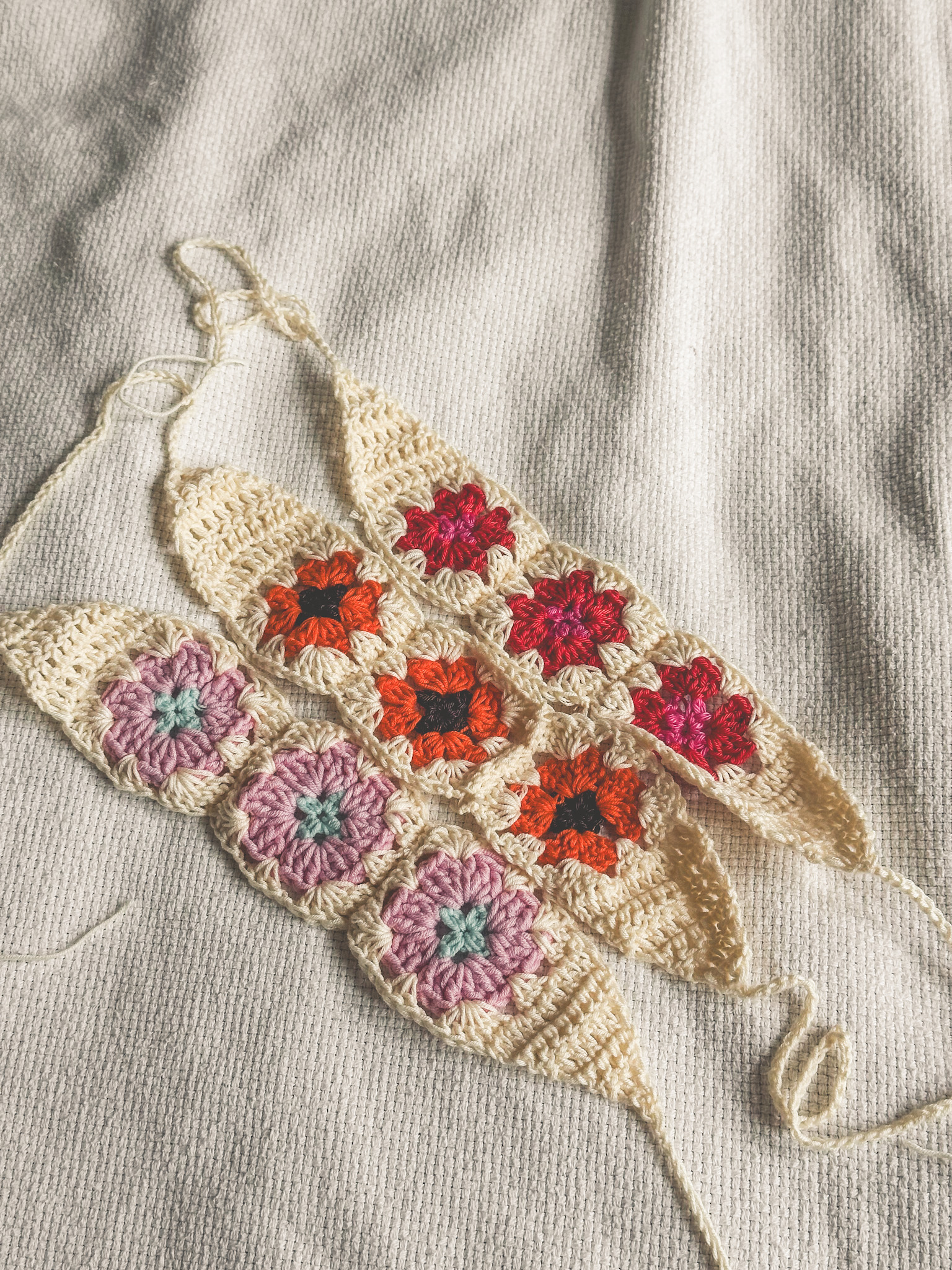
Good morning! Lately, I've had a huge flow for creating – both YouTube tutorials and paid patterns for my shop. Since I just released one new project and I'm already preparing another, I thought it's the perfect moment to take you behind the scenes.
Today, I'll tell you what the process of creating a pattern looks like for me. Everything you'll read here is based on my own experiences and tests (trial and error!). If you're thinking about designing, I hope this post will help you.
Step 1: Inspiration and learning (Pinterest)
Everything starts with inspiration, and my main mine of ideas is Pinterest. Before I sit down to design my own thing, however, I follow a certain scheme: I am constantly learning.
Between creating my own patterns, I knit projects from other creators' instructions. I want to learn new techniques and stitches because I don't know it all. When I feel confident with a given technique, I use it in my projects.
Pattern or free tutorial? How do I decide? I don't have a rigid checklist, but usually smaller, simpler projects end up as tutorials on YouTube. On the other hand, for paid patterns (PDF), I choose unique, time-consuming, and more complex things. I want what you pay for to have real and high value that would be hard to capture in one simple video.
Step 2: Knitting (Usually... twice)
Creating a pattern rarely comes out perfectly on the first try. In most cases, I make a given project at least twice.
On the first attempt, I often test, change my mind, and make mistakes (that's what happened with my last cardigan, which turned out too shallow and had to be unraveled!). The second attempt is knitting it cleanly. Thanks to this, I am sure of every stage and can logically and understandably explain the whole process without getting tangled up in the instructions.
Step 3: Writing it down as you go (My "Game Changer")
This is the most important advice for beginner designers: note everything down immediately! While knitting, I always have a small notebook with me. I write down literally every step:
-
How many stitches did I increase?
-
How many rows did I work?
-
How many centimeters is a given element?
-
How many grams of yarn did I use?
I used to not do this, and writing a finished pattern from memory was a nightmare (counting stitches on a finished sweater is no fun). Now, thanks to the notes, creating the PDF file itself takes me just an hour or two.
Step 4: Details that are often forgotten
Just knitting the sweater and writing down the rows is only half the battle. Before the project sees the light of day, I have to take care of the so-called "envelope":
-
Measuring and blocking: To give you accurate measurements in the sizing chart.
-
Tags and finishing: Sewing on aesthetic tags so the project looks professional (even if it's just for photos!).
-
Supplementary recordings (Video): I always include unlisted YouTube links in my patterns. If a certain moment (e.g., a specific join) is hard to describe in words, I record a short video that clears up any doubts.
Step 5: PDF Layout and Translation
My shop operates in two languages (PL and EN), which means double the work with files. Fortunately, I have highly automated this process for myself:
-
Graphic template: I have a ready-made template in Canva. I simply swap the text in it (copying it from my notebook) and add new photos.
-
Translation: I use the built-in translator function in Canva. With one click, I translate the file into English. Of course, I have to manually check it later and fix the formatting (bolding, knitting abbreviations), but it's still a huge time saver.
Step 6: Testers (The community is irreplaceable)
Is it worth using the help of testers? Definitely yes! Creating a pattern is a long process (for large projects, it takes months), and the creator loses objectivity after a while.
I always look for testers for new patterns because:
-
They catch mistakes: I myself tend to overlook typos or calculation errors.
-
They give valuable feedback: They suggest what could be written more clearly.
-
They provide "Social Proof": Photos of their finished works show how the pattern drapes on different body types and with different yarns.
Step 7: Marketing and Launch
Finally comes what I am working on most intensively right now – sales and marketing. The shop, newsletter, social media posts, Insta Stories, and even ads – everything has to work together.
Running your own knitting business is a challenge. For the first year, you often break even or even subsidize the business. To be able to keep creating in the long run and providing you with valuable projects, this marketing cog simply has to work.