


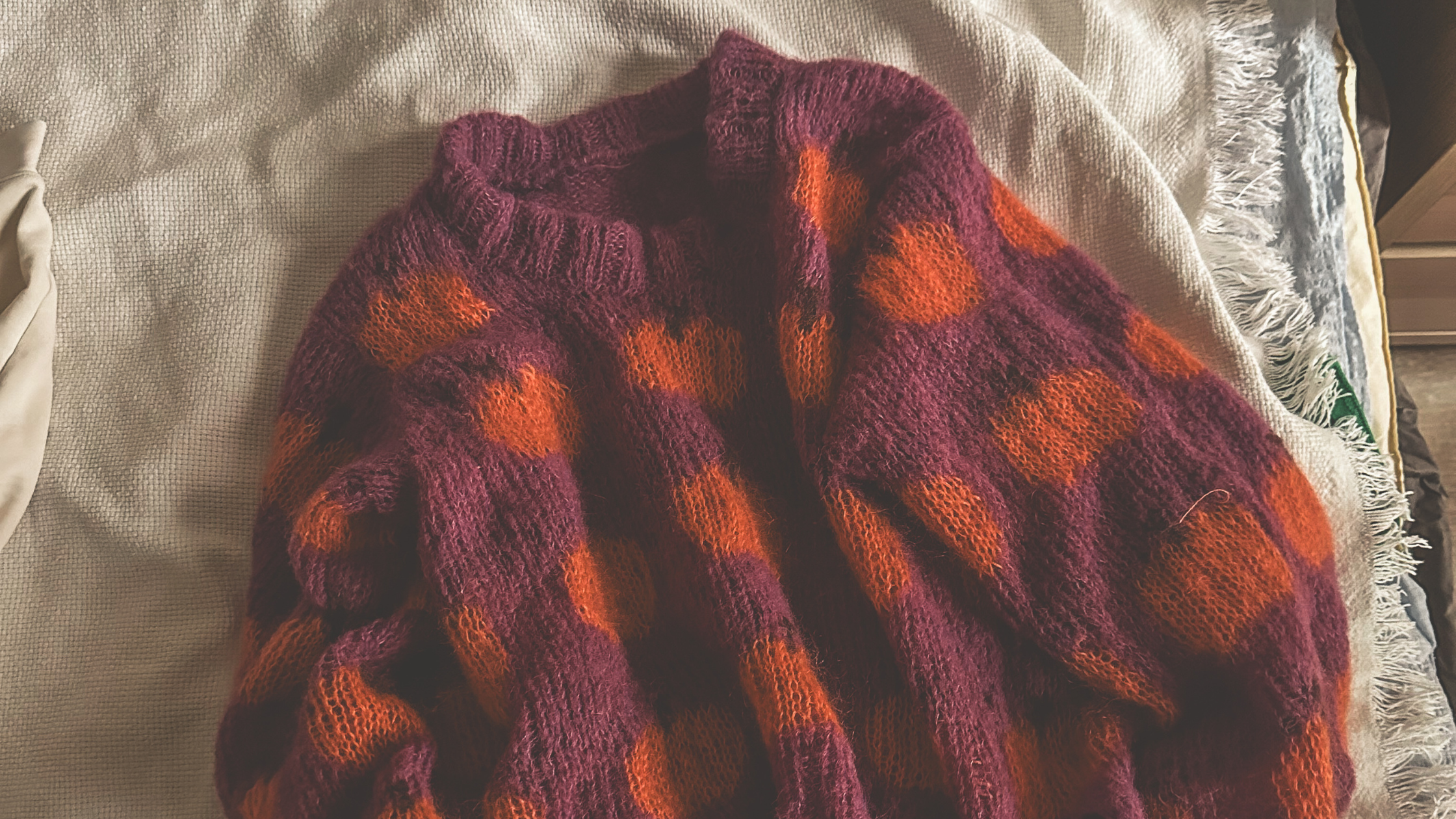
Good morning! Today we are touching on a topic that evokes both excitement and mild paralysis in many crafters: large projects. We're talking about sweaters, cardigans, trousers – clothes that require time and a solid plan.
We often abandon such projects because they seem overwhelming. But the truth is that the difference between another "project in the basket" (UFO - UnFinished Object) and a favorite wardrobe item lies in planning.
As a fan of big challenges, today I will reveal my proven 6-stage system that helps me turn inspiration into a finished product. Let's get started!
✨ Step 1: A Mine of Inspiration (and Links)
It all starts with an idea. My absolute favorite place is Pinterest. I have boards there with more ideas than I can get through in a lifetime.
But it's not just about pretty pictures. Pinterest is a mine from which you can dig up real treasures – links. I browse, look at what I like and what I really would like to wear. I don't focus on whether something looks difficult. This leads me to the next stage.
🧶 Step 2: The First Crossroads – Pattern or Your Own Vision?
Here my planning path splits into two roads:
Path A: Ready Pattern (The Easy Road) Often a photo on Pinterest leads to a creator, an Etsy shop, or a paid pattern site. If the pattern is available – I buy it. This is the simplest option. The pattern has everything: material list, step-by-step instructions, and calculations. You don't have to plan anything.
Path B: "I Think I Know" (The Creative Road) Sometimes I look at a photo and think: "Okay, I've done something similar, I can handle this." And this is where real planning begins.
🙊 Step 3: The Key Decision – Yarn Selection
This is the most important stage, which decides the final look of the project. Over the years and after testing many yarns, it's easier for me, but I still follow three iron rules.
1. Texture and Appearance
Looking at the inspiration, I evaluate how the fabric "behaves." Is it fluffy? Thin? Massive? Based on experience, I know how projects made from specific yarns look.
Real-life story: My lemon sweater was supposed to be light and fluffy. However, I chose a different yarn, and it came out massive and thick. Was it a mistake? Not exactly, because I love the sweater! But it wasn't the effect I planned.
2. Research (Lifehack)
If you aren't sure how a specific yarn will look in a finished project, do some research:
-
Browse free patterns: For example, on manufacturer sites (like Drops), you can see projects made with a specific yarn and assess its texture.
-
Check Instagram: Type the hashtag with the yarn name into the search (e.g., #DropsAir). You will see hundreds of finished projects and judge if it fits your vision.
3. Quality Over Everything (Composition)
This is my priority. I make my own clothes to have something of quality, not a fast-fashion item. I always look at the composition.
-
Summer: Cotton or linen.
-
Winter: Wool (preferably non-scratchy!).
I avoid synthetic materials. Since I dedicate dozens of hours to a project, the material must be worth it.
👀 Step 4: The "Controversial" Swatch
Yes, I know. Making swatches seems like a waste of time. I didn't do them at the beginning either because it seemed time-consuming. Until the moment I had to. And what turned out?
It doesn't take long at all!
I realized that a swatch gives me "peace of mind." Instead of wasting hours of work, I prefer to spend 15 minutes checking.
My way with swatches: I often make them very small. I don't need a full 10x10 cm. If I have X stitches in 6 cm of width, I can calculate how many stitches I need for a 40 cm sweater circumference. What's more, I rarely bind off the stitches – I just unravel the swatch and reclaim the yarn for the actual project.
📕 Step 5: Planning Construction (and Learning from Mistakes)
I rarely have a ready plan from A to Z. I usually know where I'll start (e.g., from the front of the sweater) and I have a general vision.
The key is experience. If I don't know how to execute something, I don't jump into it right away. First, I find a pattern for a similar project, make it, and learn the specific relationship (e.g., how to do raglan or shape a neckline). Only then am I able to do a similar thing independently, without a pattern.
It's constant learning. Sometimes, despite calculations, something just doesn't work out. I made a one-shoulder top that failed twice – once it was too big, once too small. It's a normal part of creating without a pattern.
😮 Step 6: Your Personal Project Journal
The last, but crucial thing: I write everything down.
I have a separate notebook – a sort of history journal of creation. I write down exactly what I did and how (if I'm making something from scratch). Why?
-
For the future: I can go back to my notes and use the same solution in another project.
-
For a tutorial/pattern: If the project turns out great, I have a ready base to create a pattern.
-
For orders: When I get an order for something I made a long time ago (e.g., hair scrunchies), I don't have to reinvent the wheel. I reach for my notes.
Planning a large project is a process that becomes easier with every sweater. Don't get discouraged if something goes wrong. Treat it as a lesson and... write down the conclusions in your journal. Good luck!
Ready for your big project? Check out my patterns!